Best Relaxation for Daily Calm: 7 Practices That Work
Table of Contents
Why Daily Calm Is a Practice, Not a Personality Trait
Breathing Exercises and the 5-4-3-2-1 Grounding Technique
How to Run the 5-4-3-2-1 Technique Step by Step
When Grounding Does Not Settle You
Mindfulness, Meditation, and Body Awareness for Mental Clarity
Gentle Movement: Yoga, Stretching, and Walking Meditation
Essential Oil Blends for Relaxation and a Calming Aromatherapy Routine
Building a Calming Aromatherapy Routine Around Your Day
Daily Relaxation Rituals That Fit 5, 15, or 30 Minutes
Nature Breaks, Journaling, and Gratitude for Emotional Well-Being
How to Take a Nature Break That Actually Works
Journaling: Two or Three Sentences Is Enough
Gratitude Without the Cheesiness
Reflection: What Helped and What Did Not
Building Your Personal Daily Calm Plan
Start With Your Real Schedule, Not an Ideal One
One-, Five-, and Ten-Minute Options
A Sample Week You Can Copy
Adapting Practices for Accessibility and Individual Needs
Troubleshooting When a Technique Does Not Help
What the Evidence Says and What to Expect
Frequently Asked Questions
Last Updated: October 6, 2026
Why Daily Calm Is a Practice, Not a Personality Trait
Some people seem born relaxed. The rest of us have to build it.
Your nervous system learns calm through repetition. Each slow breath, quiet moment, and familiar scent tells your body you are safe; do that often enough and your baseline shifts.
This guide covers seven practices that work, take as little as five minutes, and need no special equipment.
Key Takeaway Daily calm comes from small, repeated actions, not from a calm personality. Five minutes done consistently beats an hour done once.
Breathing Exercises and the 5-4-3-2-1 Grounding Technique
Slow breathing is the fastest way to settle a stressed body. The 5-4-3-2-1 grounding technique pairs it with your senses, pulling attention out of worry and into what you can see, touch, hear, smell, and taste right now.
How to Run the 5-4-3-2-1 Technique Step by Step
Total time: about 3 minutes. No equipment needed.
Name 5 things you can see. Look slowly around the room.
Name 4 things you can feel. Your feet on the floor, fabric on your skin.
Name 3 things you can hear. A fan, traffic, your own breath.
Name 2 things you can smell. Coffee, lotion, fresh air.
Name 1 thing you can taste. A sip of water works fine.
Then take one slow breath in through your nose and out through your mouth. For a deeper version, try a longer exhale than inhale. Many people find that a slow count of four in and six out feels settling.
When Grounding Does Not Settle You
Grounding does not work every time, and that is normal. If your mind keeps racing, the technique is not failing. Your stress level is simply higher than one round can handle.
Try these fixes:
Repeat the sequence two or three times instead of once
Add slow breathing before you start
Move your body first, such as standing up or shaking out your hands
If grounding never seems to help and anxiety interferes with daily life, talk to a doctor or licensed therapist. The National Institute of Mental Health resources on anxiety can point you toward support.
Mindfulness, Meditation, and Body Awareness for Mental Clarity
Mindfulness is paying attention to the present moment without judging it.
You do not need to sit cross-legged for an hour.
Body awareness works well for people who find sitting still hard.
A short meditation at lunch can reset your afternoon focus. Even a one-minute pause counts, consistency matters far more than length.
Pro Tip Pair mindfulness with a physical anchor. Rest one hand on your chest and feel it rise and fall. The touch gives your attention somewhere to land when your mind drifts.
Gentle Movement: Yoga, Stretching, and Walking Meditation
Movement calms the body in a way thinking cannot. Yoga, stretching, and walking meditation all work, pick based on your energy level.
Gentle movement tells your nervous system the threat has passed: muscles soften, breathing slows, thoughts settle.
Yoga: Try a few slow poses. Child's pose and a forward fold are good starting points.
Stretching: Hold each stretch for a few breaths. Focus on the neck, shoulders, and hips.
Walking meditation: Walk slowly and feel each step. Notice your feet meeting the ground.
Walking counts even when it is not formal meditation. A ten-minute phone-free loop around the block can shift your mood, and exercise in any form helps.
Essential Oil Blends for Relaxation and a Calming Aromatherapy Routine
Scent reaches the brain faster than almost any other sense. That is why essential oil blends for relaxation can shift your mood in seconds.
Smell is wired directly into the brain's emotion and memory centers.
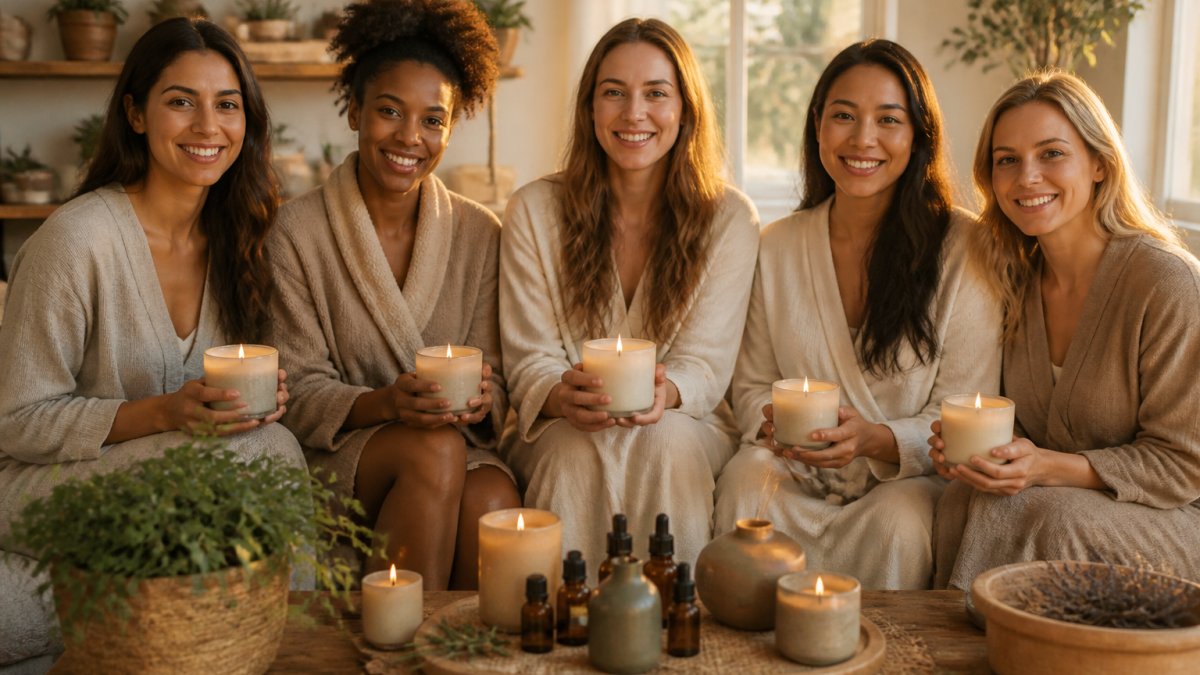
This is where Aura & Amity fits in. Our toxin-free soy candles and aromatherapy are hand-poured in small batches and guided by scent and emotion.
Building a Calming Aromatherapy Routine Around Your Day
Match the scent to the moment:
Morning: citrus or mint to wake up gently
Midday: a light floral to reset your focus
Evening: lavender or chamomile to signal rest
Keep it to one or two scents per time of day. Too many competing smells cancels the signal. For more on how scent affects mood, see the Cleveland Clinic's overview of aromatherapy.
Watch Out Never leave a burning candle unattended, and keep it away from curtains, pets, and drafts. A calming ritual should never become a safety risk.
Daily Relaxation Rituals That Fit 5, 15, or 30 Minutes
Daily relaxation rituals work best when they match your real schedule. A five-minute practice you actually do beats a thirty-minute one you skip.

Here is how to build a routine by the time you have:
Time | Practice | Best For |
5 minutes | One grounding round or slow breathing | Busy mornings, mid-day resets |
15 minutes | Walking meditation plus journaling | Lunch breaks, after work |
30 minutes | Yoga, a bath, and aromatherapy | Evenings, weekends |
Start with the five-minute version for one week, and add time only when it feels easy. Most people quit because they aim too high, not because the practice fails.
Nature Breaks, Journaling, and Gratitude for Emotional Well-Being
Time outdoors lowers stress in a way indoor rest cannot. A nature break does not require a hike, ten minutes near greenery, leaves and trees, or even a sunny window helps. Make it a break, not another task.
How to Take a Nature Break That Actually Works
A nature break works best when you leave your phone behind or silence it. Let your attention rest on what is steady and slow: light through leaves, wind, birds, air on your skin.
Try one of these:
Window version (2 minutes): Stand near a window, look at something green, and take five slow breaths.
Doorway version (5 minutes): Step outside, walk to the end of your block, and back.
Park version (10 minutes): Sit on a bench or grass. Notice five things you can see, four you can hear, and three you can feel.
Barefoot walking on grass or sand is a simple form of grounding many people find soothing, and time outdoors breaks the screen time loop that keeps your mind buzzing.
Journaling: Two or Three Sentences Is Enough
Journaling works on the mental side. You do not need a leather-bound notebook or a thirty-minute block. Two or three sentences is enough. The point is to train your attention toward what is steady, not what is threatening.
A simple pattern to copy:
One thing that went well today. Be specific. "I finished the report" beats "good day."
One thing that felt hard. Naming it often loosens its grip.
One thing you are looking forward to. Even something small counts.
Keep it short. If you miss a day, pick it up the next day. The habit matters more than the streak.
Gratitude Without the Cheesiness
Gratitude gets a bad reputation because it is often taught in a vague, forced way. Specific gratitude works better: instead of "I am grateful for my family," try "I am grateful my sister called me on Tuesday." Name three specific things at the end of the day, journaled or said out loud before bed.
Reflection: What Helped and What Did Not
Reflection is the quiet step most people skip. Once a week, ask two questions:
What helped me feel calmer this week?
What did not help, and can I drop it?
These habits build resilience over time. They also support emotional well-being and a more settled, positive thinking pattern. If stress or low mood persists despite these practices, talk to a doctor or licensed therapist. The Substance Abuse and Mental Health Services Administration helpline offers free, confidential support.
Pro Tip Pair one outdoor break with one short journal note. The combination is easier to remember than either habit alone, and it takes less than fifteen minutes total.
Building Your Personal Daily Calm Plan
A daily calm plan is a short list of practices you will actually do, matched to your schedule and needs. It is not a program you buy, it is a routine you build, with one-, five-, and ten-minute options for busy days.
Start With Your Real Schedule, Not an Ideal One
Before you pick a practice, pick a time you already have. Anchor calm to something you already do, right after coffee, during a lunch break, after you close your laptop, or before bed. The anchor does the remembering for you.
Use this simple framework:
Pick one anchor time, such as right after coffee or before bed.
Choose one practice from each area: breath, movement, scent.
Set a minimum version for bad days. One minute counts.
Track it for two weeks. Keep what helps, drop what does not.
One-, Five-, and Ten-Minute Options
Most people quit because they aim too high, not because the practice fails. Match the practice to the time you actually have:
Time | Practice | Best For |
1 minute | One slow breath in through the nose, longer out through the mouth | Red lights, between meetings, before a hard conversation |
5 minutes | One grounding round or slow breathing | Busy mornings, mid-day resets |
10 minutes | Walking meditation plus a two-sentence journal note | Lunch breaks, after work |
30 minutes | Yoga, a bath, and aromatherapy | Evenings, weekends |
Start with the one-minute version for three days, and add time only when it feels easy. A five-minute practice you actually do beats a thirty-minute one you skip.
A Sample Week You Can Copy
This is not a prescription. It is an example of how the pieces fit together.
Monday: 1-minute breath at your desk before your first meeting.
Tuesday: 5-minute grounding round after lunch.
Wednesday: 10-minute walk without your phone.
No workday asks for more than ten minutes. That is intentional, consistency matters far more than length.
Adapting Practices for Accessibility and Individual Needs
Not every practice fits every body. If sitting on the floor is hard, do breathwork in a chair. If walking is limited, try seated stretches or hand movements.
For sensory-sensitive readers, keep the room dim, choose one input at a time, and avoid strong smells. For low-mobility readers, seated breathwork, body scan, and gentle neck and shoulder rolls work well.
Troubleshooting When a Technique Does Not Help
If a practice does not help after a fair trial, that is useful information, not failure. Try these adjustments first:
Shorten it. A one-minute version may work when five minutes feels like too much.
Change the channel. If breathwork makes you more anxious, switch to movement, scent, or sound.
Change the time. Some people settle best in the morning; others need the evening.
If a technique never seems to help and stress interferes with daily life, talk to a doctor or licensed therapist. These practices support your well-being. They do not replace professional care. The Substance Abuse and Mental Health Services Administration helpline offers free, confidential support.
What the Evidence Says and What to Expect
Be realistic about results. Breathing, meditation, and time in nature have real support behind them, but they are not cures, they lower stress over weeks, not seconds.
Expect small shifts first. If a technique does not help after a fair trial, that is useful information, not failure. The National Institute of Mental Health resources on anxiety can point you toward support.
Key Takeaway A daily calm plan is a short list of practices matched to your real schedule. Start with one minute, add time only when the short version feels easy, and adjust rather than quit when something does not work.
Frequently Asked Questions
What calms you down immediately?
Slow breathing is the fastest physical lever. Try a longer exhale than inhale, such as in for four counts and out for six, for two minutes. Pair it with the 5-4-3-2-1 grounding technique: name five things you see, four you feel, three you hear, two you smell, and one you taste. This combination interrupts the stress response and returns attention to the present, which is why it works in under five minutes.
Which essential oil blends are commonly used for relaxation?
Lavender is the most studied single oil for relaxation. Common blends pair it with bergamot, chamomile, cedarwood, or sweet orange. For a simple calming aromatherapy routine, add a few drops to a diffuser 30 minutes before bed, or dilute with a carrier oil and apply to wrists. Choose toxin-free, small-batch products if you have sensitivities, and patch test before regular use.
How can I create a relaxing daily routine if I am too busy for long rituals?
Anchor one practice to something you already do. Inhale slowly while your coffee brews, run the 5-4-3-2-1 technique in the car before walking in the door, or light a candle during your evening skincare. Five minutes of daily relaxation rituals done consistently builds more resilience than an hour once a month, and the habit sticks because it rides on an existing cue.
Is aromatherapy backed by science or just a placebo?
Research on lavender and citrus oils shows measurable effects on self-reported anxiety and sleep quality, though study sizes are often small and results vary by person. Aromatherapy works best as one layer of a broader routine that includes breathing, movement, and sleep hygiene. If a scent helps you slow down and breathe, that response is real and useful regardless of how much of it is chemical versus psychological.
Calm is not something you find once. It is something you rebuild, a little at a time, until it becomes your normal. At Aura & Amity, we make that easier with toxin-free soy candles, botanical body care, and aromatherapy designed as sensory rituals for real life. Every product is hand-poured in small batches and created by a licensed mental health therapist. Start with one five-minute ritual tonight. Shop Now and let your home become a daily sanctuary.
Shop Now

Comments